Friday, 8 September 2006

Finding Answers and Power of Questions

I just saw a post by Mike Oehlert on the Power of Questions where he says:


So then I read about how Yahoo!, MSN and another service called AnswerBag are valuing the question (Google Answers is also in the mix along with AllExperts). These folks are all offering services which allow you to post your question to a community and get answers. Some allow people to offer those answers to you for a small price (couple of dollars). They are also integrating RSS feeds into these technologies so that you can subscribe to an answer stream and some are even integrating it into your Instant Message client.

When I read stories like this, I wonder if there is some huge technical hurdle
I'm missing which is preventing this kind of thing from catching on in the
corporate/government world or if it really just boils down to a question of
culture again.
This has been done for quite a while in corporate environments through a variety of mechanisms. However, it's about to heat up again both across organizational boundaries and within companies because of having lighterweight solutions. A good example is Illumio that basically uses the contents of what is in your email to determine what you may know about and will route questions to you based on that information.

What's interesting is that this maps nicely to part of how we learn. Once we've formulated basic information, we can then postulate questions that we want to get answers from multiple people.

Of course, we are going to have hurdles with getting people able to pull together intelligent questions and getting some people to be willing to participate. But, I believe with the lower technology hurdles coming about now there will be incremental adoption in the enterprise.

Thursday, 7 September 2006

eLearning 1.0 vs. 2.0 - Help Needed

I want to try an experiment. I think there's an interesting bit of content in here, but in exchange, I would ask that you maybe throw me a bone and answer a question or two in exchange.

I'm still preparing for a couple of presentations at DevLearn and a presentation for ASTD Los Angeles - What's Next in eLearning? (Actually that presentation is virtual so if you read this blog and are interested in attending, I can talk to the organizer.)

In any case, I need help figuring out the best way to explain the trends going on in eLearning. I'm going to put in my current figure, but I'm not happy with it or necessarily how I'm presenting it, so I'd like some feedback.
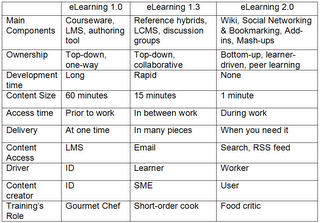

The basic trend that I see in eLearning is that we've really started down a couple of new paths that I've label eLearning 1.0, eLearning 1.3 (I'll explain that in a minute) and eLearning 2.0. My first problem is that the labels include the version number that implies that we simply get rid of the old version when we upgrade. That's not really the case. A better analogy is an Oven and a Microwave. Just because you have the new technology doesn't mean you cook everything in it.

Question 1 - What's a good technology analogy that has 3 generations and where
you still keep prior generations around?

Okay, so now let me confess why I'm calling it eLearning 1.3. It's because that dang Clive Sheppard has patented "Learning 1.5" (Clive on Learning: Learning 1.5 - for those who prefer evolution to revolution). No, actually, it's because I think the distance from eLearning 1.0 to eLearning 1.3 is shorter.

Question 2 - I know that some people hate the term eLearning 2.0, but it seems that this is better than any alternative I've heard. Any suggestions on what to call the columns? Maybe the answer to Question 1 would help.

In the eLearning 1.3 column, I'm trying to represent a lot of what is happening today in corporate learning. While we've not really let go of eLearning 1.0, we are being forced to build learning more quickly, in smaller learning bursts and often can be accessed as reference as well as up-front learning. Many times the SMEs are doing some of the content creation and definitely more maintenance. Because of that we're using fewer desktop based authoring solutions and moving towards web-delivered authoring.

My guess is that most folks in corporate eLearning can identify with the above trends. Here's where it gets trickier.

LMS - Some folks have gone away from the LMS for a big chunk of their learning. Thus, delivery of content is initially through email and then through the intranet on an on-going basis. Other folks keep their eLearning content under the LMS. Clearly by the time you get to eLearning 2.0 with user generated content, the LMS has to change. Further the trend in Web 2.0 suggest that lightweight solutions win out over more complex, controlling kinds of solutions like an LMS.

Question 3 - Is the use of the LMS important to understanding this trend? Does it matter that there's been somewhat of a backlash and I expect that to continue?

Collaborative Learning - There's definitely a trend (as pointed to by Clive as well) in using collaborative tools as part of what is otherwise an eLearning 1.0 kind of solution. This is certainly not eLearning 2.0 and not really eLearning 1.3 by itself. But, it seems like it heads you towards thinking about learning occurring through peer interaction and helps you move towards eLearning 2.0. Thus, I've included it in the eLearning 1.3 column even though that really feels not quite right.

Question 4 - What should I do about Collaborative Learning?

Finally, I'm trying to convey in the last row the changing role of Training in each of these approaches. I've tried a bunch of different analogies and not found one that I like. Currently, I say Gourmet Chef because we get an order for some really great learning and pull together the best ingredients and create something really spectacular (actually I've probably not been a gourmet chef since 1993). Short-order cook because we still take orders, but people expect it fast and cheap and they are going to eat quick. Food critic because we don't even create the content any more but we do help people make sense of content that's being created.

Realistically, the dramatic shift between eLearning 1.0 and 1.3 is changing to being responsible for tools and process that SMEs can use to create content. In eLearning 2.0 we do that as well except for it's end users creating content (hopefully they are SMEs too). But we also add the responsibility for aggregating the content into helpful guides, etc.

Question 5 - Is this analogy helpful? Would you ditch it? Change it?


That's it. I'm really hoping I'll get some feedback on this.

Keywords: eLearning Trends, eLearning 2.0, Web 2.0, Informal Learning, Collaborative Learning

Wednesday, 6 September 2006

Better Discussion / Debate in Learning

Mark Oehlert post: I long for this kind of debate in our learning circles.... talks about something that definitely stuck a chord for me. In particular, he laments that as he was reading a discussion in a different domain and "working on the team picking out sessions for the 2007 ASTD conference" he found himself wanting to have better discussion and debate in our world of learning.

Mark - I do too!

However, as I continued to read Mark's post, I realized that he and I may not want the same thing. He says -
Now some folks, notably Jay Cross (along with Harold Jarche and Judy Brown) have been exploring the "unworkshop" and they are to be applauded. But this is not a desire to have the learning/training version of FOO Camp or Bar Camp but something more.
Actually, I think that maybe FOO Camp and Bar Camp aren't quite the right format, but having the kind of dialog that occurs at unconferences is definitely needed at corporate learning conferences, e.g., ASTD, Training, etc. I've talked about More Effective Conferences for Learning Professionals but as I explored this, I realized that the real challenge was Better Questions for Learning Professionals. Without having some really interesting questions, then conference organizers default to putting signs on tables with general topics, e.g., healthcare or simulations. We've all seen this. Then you sit around the table with little or no real dialog. But, it's more because we are not prepared with real, interesting questions.

Mark seemed to come to a similar conclusion as he provides examples of questions that he would find really interesting:
I want a thoughtful discussion of what we do. Not about your LMS. Not about your 'issues.' But about why we believe what we do is worthwhile and why anyone should pay any of us to do it. What are the theoretical underpinnings of our industry? Kirkpatrick? Bloom? Piaget? When is the last time you went to a conference, billed as a conference about learning, and heard someone stand up and say the Bloom is full of crap? That Gagne's Nine Events of Instruction is fundamentally flawed? That new breakthroughs in the field of cognitive science or neurobiology are shifting how we think about learning?
The good news is that Mark and I have had a little discourse on the definition of informal learning (along with input from George Siemens, Harold Jarche and Dave Lee) and it really help me to understand some of the different definitions of informal learning. So, I would suggest that the discussion occurring today is having some impact, but as Mark suggests it seems few and far between. And I'm not sure why that is. It would seem that we should be the best at this. Cobbler's shoes maybe?

Of course, now the bad news... I pretty much disagree with Mark on what are the important/interesting questions ... I do want to talk about "your issues" ... actually, "your real issues" ... how you can make a true impact on human performance and business performance. I think that the questions about Kirkpatrick, Bloom and Gagne are only going to hit home for me if you put them in context.

But, this does get me to thinking again about Better Questions for Learning Professionals and even more:
What are the controversial questions facing us today in Corporate Learning?

Tuesday, 5 September 2006

Q&A - eLearning Standards Especially SCORM

Now that I posted about Better Questions for Learning Professionals, I've been receiving questions via email from a variety of people. That's great! I like getting interesting questions. Some of them I just respond with an email. But, I'm going to try to make a practice of creating blog posts around some of the questions.

Here's a recent one to get me started:

  • Is it mandatory to use SCORM while developing an E-learning Software?

    SCORM is as close as you get to Mandatory in the world of eLearning. You want to implement your courseware to the SCORM standard if you plan to have it launched and/or tracked under an LMS. SCORM is a fairly easy standard to deal with especially since most people are fine with a single SCO that does only single score/completion reporting. More than that is most often not expected and can cause you integration problems.

    There are a couple of situations where SCORM gets dropped. One case is building a one-off course that needs simple tracking/reporting and will never run under an LMS. If you won't ever need to run it under an LMS, then SCORM is overhead you don't need (see Tracking Without an LMS).

    The other situation is if you are building something that is not a course, e.g., it's reference material. In these cases, I'm not tracking and likely it's not under the LMS. Most LMS systems have ways to launch these kinds of reference systems (they are just a web page after all).

  • What about other Standards?

    AICC goes after the same thing as what I've described above for SCORM (tracking under an LMS). However, it is less common now than SCORM and it is harder to implement (which is why it's less common). Once in a while, you will still run into this. Most of the time, it's to handle cross-domain issues, i.e., learning content is on different server than learning management. I've also seen it in an environment that had certain restrictions on JavaScript.

    There are a bunch of other standards by ADL (who is responsible for SCORM), IMS, IEEE LTSC including CORDRA™, LOM, Meta-data, etc. in the eLearning world. However, as Pierre pointed out in the comments (and I've edited the text here based on his comments - thanks Pierre) - ADL's SCORM really incorporates what we need from these other standards and thus we've not needed to spend effort going into these standards separately. (Note: ARIADNE, AICC, IEEE LTSC, and IMS all participate in ADL's work on SCORM).

    There are also standards such as WebDAV that are going to be important for authoring tool implementations in the next few years. So, when I've been consulting with vendors who are working on any kind of authoring system, that was a particularly interesting standard.

  • Can we develop the same project using : Java, JSP, J2EE, XML, Oracle, Flash combination?

    This certainly can be used. Flash may make it a litttrickierker to implement SCORM, but there are lots of resources on how to do that. SCORM uses JavaScript to communicate so you will need to embed a bit of JavaScript code on the pages your application generates.


Couple of quick updates to this post on Sept. 6, 2006:

Judy Brown has left her long time position, but the good news is that she is writing a blog - SCORM Watch. Love the name, love the blog, and we all love Judy. In her blog she pointed to a bunch of great SCORM related resources:
  • Jennifer Brooks of the ADL Co-Lab shares experiences and lessons learned through facing these issues.

  • David J McClelland shares his experiences and a standard troubleshooting method for SCORM content in his blog. (Great post on issues that many of us have faced!)

  • This does not appear to be a new posting, but one that I recently found for the ToolBook community, but it is relevant for all. Included are: the business case for SCORM; overview of SCORM including kinds of SCORM learning objects, online or offline learning objects, and organizing and sequencing learning objects; organizing learning objects and SCOs; implementing SCORM-compliant learning objects and SCOs; and packaging SCORM-compliant content. The chart on cost of content integration before SCORM and with SCORM is very interesting.

  • And - Suresh Susarla, the Business Analyst in the Workforce ADL Co-Lab at the University of Memphis in Memphis, Tennessee, asks important questions to determine whether you need SCORM:

    • Do you need to control learner access to courseware, track learner progress, or monitor the effectiveness of your e-learning content?
    • Do you want to be able to control the learner’s path through the content in some way?
    • Do you plan to develop content in house and also purchase content from one or more third-party content vendors?
    • Do you plan to use the content for multiple new audiences in the future?
    • Do you plan to reuse parts of the content in future courses?
    • Are you planning to redistribute or sell the content to another
      organization?

Goodbye LMS?

I had seen this paper (Social software: E-learning beyond learning management systems) before, but Jay Cross's take on the implications of the paper in LMS, we hardly knew ye is interesting:

LMS create a walled garden in an era when walls are falling down. Why not use
the real internet and real internet technology rather than some hokey
oversimplification? Furthermore, how can you manage serendipitous learning that
is inherently unmanageable?

I get the feeling that Jay and I are responding to what is happening out in the world of corporate use of LMS products and this is something I've been writing about before:

The paper about social software is definitely worth reading to get up to speed on issues such as Integration vs. Separation (or as I called it Point Solutions vs. Suites and Composition), their introduction to Social Software from a learning context, and their point that LMS products are incompatible with a learner-driven environment.

However, I agree with Jay that the bigger reason that LMS products are causing us grief in corporate learning applications is that while we want some aspects of what an LMS provides, we don't want our content to get stuck inside the LMS in the form of a course that makes in useless in other modes. Further, it causes us to think in LMS terms (course).

The counter argument for why we need an LMS centers first and foremost on tracking required learning and secondarily on helping to communicate learning requirements. This makes me wonder if we wouldn't be happier ourselves and for our learners to have a system with the following main functions:

  1. Invisible tracking - tracks the web pages that each individual visits and activity that it corresponds to. This is similar to web log analysis today, but would include tracking of the individual via cookies and analysis to say that if you hit particular pages, then a particular event occurs.
  2. Email blast utility - give us tools to communicate to individuals and allow it to base communication on event completion or selection criteria.
  3. Reporting - tell us who has completed what events

The advantage of this kind of approach is that it breaks down the walls so that content is just content and still gives us the necessary tracking and communication. You'll notice that I've not included any method of communicating about particular learning requirements. My assumptions is that you'll just create emails or web pages that tells people what they need to do.

If we believe that Course and Courseware Fading and that much of the learning content that we'll provide in the future will be in the form of things that do not look like courses, then don't we have to move to this kind of learning tracking and communication system?

Of course, The Innovator's Dilemma of Learning suggests that this solution may not not come from any of the big LMS players (see also Do You WANT an LMS? Does a Learner WANT an LMS?).

Thursday, 31 August 2006

Perspective in Blogs (or how Guy Kawasaki almost ruined my blogging experience)

The other day I ran across Guy Kawasaki's Signum sine tinnitu blog. I've always enjoyed Guy's speaking so I spent some time on his blog (really good stuff), but then I ran across The First 100 Days: Observations of a Nouveau Blogger where he says:
The more a blogger uses the pronoun “I,” the less he has to say. Many
bloggers apparently believe that people not only give a shiitake about
everything they say, but that these people are hanging on to every word.

If you notice my first paragraph (which is fairly standard in my blog) it contains four "I"s. Uh oh. So, for a couple of days, I've been self-conscious about the number of "I"s in my blog. My experience has been a little like an experience in college when a we challenged a student who used his hands a lot to try to go through our after dinner conversation sitting on his hands. He could barely get a thought out of his head.

Damn you Guy!

The good news is that I've been able to rationalize the word "I" in blogs. Much of what I look for in other writers' blog posts is their experience and their perspective/opinion. In fact, one CEO group that I was part of drilled into your head to never give advice directly, but rather provide relevant personal experience that might help you draw your own conclusion.

In fact, I'm happy to read Guy's opinion about using the word "I" ... and his experience that people like me who use it a lot may not have much to say ... Luckily, I've come to ignore this advice ... but that's just "I" (dang if only that was grammatically correct).

Wednesday, 30 August 2006

First Time Visitor Guide

Updated 12/03/2009 ... based on 2009 Top Posts and Topics
Update 12/03/2008 ... based on 2008 2009.

It can be daunting to visit a blog for the first time. The author(s) have been writing individual articles for months or years. This is my attempt to help you get a sense of topics of my blog and find some of the more interesting past articles.

Managing your RSS Feeds - If you are considering subscribing to this blog, you might want to read this.

Blog Description

This blog covers trends in eLearning and more broadly the use of technology that aims to improve human performance. This is fairly wide ranging from traditional courseware kinds of issues to specialized kinds of tools and sites. My background includes things like being the acting CTO of eHarmony (online marriage matching based on personality profiles and controlled communication) from its launch through their $110M venture round to working on interesting eLearning and tools for companies like Lexus, HP, IBM, etc. Thus, the blog has a tendency to jump into a wide range of technology types and solutions. I do generally focus from a corporate standpoint (not as much in the education realm). Of course, you'll get a better sense of this as you read through various post.

Interaction

I write this blog because it helps me think through and learn about the topics I write about. Interacting with readers and other bloggers on these topics really helps to expand and/or clarify my thinking. What I want (and what most bloggers want) is for readers to engage with me. Please Leave Comment - they are very much welcome.

In fact why don't you start interacting right now by briefly introducing yourself in the comments below.

You could also engage with me via your blog and respond to Conversation Topics. I will do my best to respond to you and link to your blog. Of course, that assumes you've decided to blog. If you are still thinking about it, take a look at Top Ten Reasons To Blog and Top Ten Not to Blog.

You should also take an opportunity to link to me on LinkedIn. Read why in my post: LinkedIn Connection Approach Rethought. You might also want to look at my LinkedIn Guide for Knowledge Workers.

Topics

eLearning 2.0

Starting Point:

Practical Suggestions:

Issues:
Informal Learning

Personal Learning
Blogging
eLearning Trends

eLearning Resources

Learning Management Systems

Facebook

Work Skills and Knowledge Work and Work Literacy

SharePoint

Long Tail

Other Popular Articles

Other Topic Pages
Girls Generation - Korean