Monday, 18 September 2006

Monday Question - Learning Design Different Now?

Jim Belshaw suggested in a comment on a previous post suggested that a good model for a blog is to post a question each week that might stimulate discourse (something that many of us want). The question today actually comes from a Lee Kraus post. The basic question is:

How is Learning Design different when we are using different learning techniques, especially bottom-up techniques based on personal learning and informal learning?

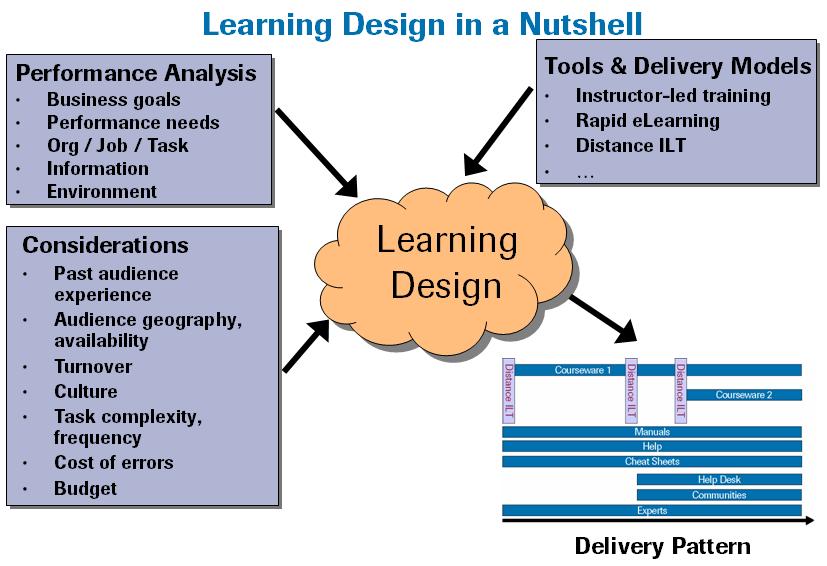
To help provide some context for this question, in a previous post I provided the following mental model of Learning Design:


The question Lee asked is whether this is the reality given that with new models of eLearning (see: eLearning 1.0, eLearning 1.3 and eLearning 2.0) where SMEs and the Worker / Learner play an increasingly central role in content development. For eLearning 1.3, much of the content is created as Rapid eLearning by SMEs. In eLearning 2.0, content is created by the Worker / Learner. At a crude level, we might consider the picture under these models to be more like:


This picture is meant to imply that while there may still be some traditional up-front learning design content creation will increasingly be done by SMEs and the Worker / Learner. Further, it will likely be done later in the process in an on-going way. IDs may play an on-going role of providing structure to the content, but they don't create nearly as much content. Instead, we will push tools to the SMEs or Worker / Learners to allow them to create their own content.

Given this context, the question: Is Performance Analysis the same? Do we look at the same Considerations? Or are we doing something very different? If it's different, then the natural question is: can our current understanding of Performance Consulting / ISD / ADDIE / etc. help us under the new model? Alternatively, feel free to tell me that this is the dumbest question you ever heard (and hopefully why).

Feel free to either add comments here, or to create a blog post and post a link to your post in the comments.

Thursday, 14 September 2006

Be an Insanely Great Professional Conference Attendee (at eLearningGuild’s DevLearn)

As way of introduction to this topic, let me start with a typical scenario that you will recognize if you’ve ever attended a professional conference…

It’s noon and you are heading into the lunch area. The conference organizer has put signs in the middle of each table with a topic. One of the topics is LMS and there’s a seat available, so you sit down. You introduce yourself to the people sitting to your left and right. You ask each other the natural questions. “So what LMS are you using? How do you like it?” They respond with a superficial answer. And you go on with “Hmmm … that’s great. Do you have any plans while you are in town?”
Well you tried right. C’mon we’ve all been there. We’ve all gone through similar motions. If anything that’s the normal conversation. But let’s compare…


You walk in. Sit down at the LMS table. Introduce yourself. Then you say, “We are beginning to use more reference materials as part of the learning and back on the job. We’d like this to be tracked through the LMS, but we are running into a problem that if we try to track it, then the LMS makes you jump through a couple of hurdles to access it. Are any of you using reference material? Are you tracking it? How?”
Hopefully it’s obvious that everyone else at the table is going to enjoy their lunch conversation a lot more because of your questions and, of course, you are going to get a lot more out of the conversation.

What’s the difference between the two? If you read my blog you know the answer … Better Questions.

If you are planning to attend DevLearn in October, and really even if you aren’t but want to figure out what questions you really have, I would highly encourage you to TAKE ACTION by thinking through the questions you have about eLearning and CONTRIBUTING YOUR QUESTIONS AT THE END OF THIS POST. Psst … it’s also the

Secret to Being an Insanely Great Conference Attendee =>

Find Your Good Questions

At a conference, you will get significantly more from the conference by being prepared with better questions. And it’s not only lunch conversations. You’ll get more from walking around the expo floor … have you found yourself wandering aimlessly … that’s because you don’t have questions. You’ll get more from sessions you attend. And the speaker would LOVE it if you sent them questions ahead of their session.

Finding Your Good Questions

The old adage used to be “There’s no such thing as a bad question.” Unfortunately, if you’ve ever been a teacher or professor – actually a person – you know that there’s a spectrum of questions from bad (yes there are some) to really good. Good questions provide some context. They dig a little deeper. And, yes, they require a bit of thinking to find.

My suggestion is that you start by recognizing that likely questions are going to come from a variety of perspectives: career, project, learning department, and internal/external clients.

Let me give you some examples of questions that I think may foster a better conference:

Career

  • I have a background/degree in ISD. I’ve been creating simple courseware using Lectora. But it seems like more and more of our content is going towards reference materials and we are using more rapid eLearning where there’s really not much instructional design. What kind of job can I do with my ISD background given this shift in how things are being done? Are there new skills I should be learning? How about studying Information Architecture?

Learning Department

  • We currently have three multitalented individuals creating courses in Lectora and Captivate. Each individual is assigned to a particular project and they do it all from start-to-finish including: ID, writing, authoring. Of course, we have slightly different talent in each of the areas so we try to assign the person based on the needs of the project. Should we consider restructuring the department so that we have specialists and so that they work as a team on projects? Will we get more or less done? Will the extra communication eat up any efficiencies we gain?

Internal/External Clients

  • We are helping store managers who are responsible for their store’s customer satisfaction ratings. We have numbers that tell us what areas need to be worked on, but we can’t directly reach into the stores and touch the employees. We have to work through the store manager. What kinds of tools, techniques can we use to help the store manager effectively train and coach employees given particular customer sat problems in the store? Have other people tackled this problem or similar problems?

Techniques / Technology / Tools

  • We’d like to use video for some of our training, but we’re concerned about bandwidth limitations. How can we determine if video will work on our network? Is there a cost effective way to test? What technologies might allow us to try it out on a limited basis without investing a lot? Are other people doing this? Did they do any load evaluation? Or how did they test and roll it out?
  • With SecondLife being used as a venue by Harvard Extension for a class, does this suggest that this technology should be considered? Has anyone really used it? What was the result? Why should I believe that using SecondLife or any virtual environment would actually result in better learning? Isn’t it just a fun gimmick that would get in the way of learning?

I’d love to hear these questions discussed at lunch, at a session, on the expo floor. While not every attendee is going to be interested in every question and certainly not everyone can contribute to every question, I’m confident that if you spend time finding your questions, you will get more from the conference. And, I'm sure that if you post your questions in the comments on this blog you will also get value.

Most people who attend eLearning conferences (such as DevLearn) have been working in the field for quite a while. How many questions do you think you might have?

Go ahead – add a comment right now to this post with a couple questions! No really. Do it!


Exposure / Novice Questions

What do you do if you don’t know enough to formulate a specific question? What do you do if your goal around a topic is just “exposure to what other people are doing”?

In these cases, the basic rubric is to ask: how does this topic apply to me and my situation?
Look at the topic and consider – how does it (if at all) apply to my situation?

I think it’s somewhat of a cop out to say – “I’m just coming to get exposure to .” Let’s pick a topic ... maybe, video. Let’s say you don’t know anything about technical aspects of video. But, if you are even interested in the topic, it must be because you think there may be some need. So, maybe your question is "Does this apply to my topics?" Maybe it’s "How can I easily create something for testing."

Do spend a little time thinking about your context and the topic area and figure out what you should say at the appropriate lunch table. And it’s not “I’m just here for exposure.”

Planning Your Conference

Once you have formulated your questions as best you can and posted them as a comment in this blog (Note:… if I get flood, then DevLearn has promised to help handle it … it’s a good problem not a bad one… ) … then you should go back and look at the conference program and consider how you can get your questions answered.

  • Who might you want to meet with who would have answers?
  • What sessions might have content?
  • What are other activities at the conference where I can talk to people?
  • How can I meet up with other people who have similar issues or have experience with my questions?

I bet that based on your questions, you will be able to figure out answers to this stuff. If not, then the conference organizer will be more than happy to help you figure out the answer.

One of my clients right now runs a trade show in a completely different industry. They see their mission as helping constiuents find help, answers, etc. They are truly committed to doing that. But, they only can help those who seek help. The smartest people take them up by figuring out what help they need. Do the same thing! Find Your Questions! Post Them! Be insanely great!

Wikis - Public vs. Controlled - Why There's No eLearning Wiki

Update Sept. 18, 2006 - see http://www.citizendium.org/ - which aims to address exactly the issues I'm discussing below in Wikipedia.

I received an email asking me if I knew of any Wikis that provided information on eLearning concepts. First, let me say that I really like getting questions. But, has anyone noticed that blogs don't provide a means of asking questions that are not specific to a particular post? Thus, folks must send me email which is fine, but it means that people who read my blog can't post answers. I guess I could create a "Questions" post where questions could be added in the comment. Does that make sense?

Okay, onto the question ... the short answer is "None that I know" ... there's not really a place where you can find a Wiki that covers eLearning concepts.

But the answer is much more interesting than that. You can certainly go to Wikipedia and find information about learning concepts including eLearning and eLearning 2.0. However, Wikipedia has some issues (as does any public Wiki) as a place for defining these terms. The issue is how you balance commercial activity (e.g., vendors posting a link to their product) vs. being a comprehensive resource vs. being too leading edge.

The article on eLearning 2.0 which I originally created but that now I've been told that I'm too commercial to have links to any of my blog posts even though there are links to other blog posts by other folks who are commercial. So, I'm going to wait until my articles and presentations on eLearning 2.0 are available and then I'll go back and edit the post. Sheesh. It's definitely a bummer and has turned me off to contributing to Wikipedia even though it could be the place where definitions could go, e.g., rapid eLearning, informal learning, etc.

What's even more tricky is what do you do about having a page on Rapid eLearning that might list products that are rapid eLearning tools. This is done on Wikipedia for some topics, e.g., List of Wiki Software. But, Wikipedia, in general, is trying to avoid allowing links to products. It just invites too many problems.

So, while it would be great to have a page that was the definition of Rapid eLearning with links to all the relevant tools. I personally believe that it won't happen on Wikipedia.

Why isn't it happening elsewhere? Theoretically, ASTD's Learning Circuits or the eLearningGuild should do it right? Both organizations have played with creating and using Wikis, but unless there is critical mass of content and visitors, unless they become the defacto standard of where you find this information then you won't get sufficient content. Further, they will be competing with lots of individual sources of similar information and will pale in comparison at first. And, they will face the exact same issue around commercialism. Of course, they do have the advantage of being able to limit contribution based on membership and members are far less likely to blatently violate rules around commercialism.

I would suggest that this will happen at some point. Heidi Fisk? Dave Lee? Any comment?

Now before people jump to the conclusion that my experience on Wikipedia suggests that Wikis have problems as a tool to use in learning... Nothing could be farther from the truth. I actually think that Wikis are a fantastic tool for putting up reference materials and that in many corporate environments, they have become a means for people throughout the organization to easily contribute content. In a controlled environment, Wikis are a fantastic tool.

After my presentations at DevLearn - I'll have more to say on this subject.
Wednesday, 13 September 2006

Learning Design in a Nut Shell

I've recently updated my mental model of how I go about Learning Design, so I thought I'd share.


These days is that we have such a big mix of different delivery models, tools, etc. and such different kinds of blends that emerge that it's difficult to feel comfortable and confident with what tools to use in what situation.

In fact, the Art of Learning Design is dealing with the variability of the myriad of performance needs, considerations and possible delivery models and tools; working through the combinations; to arrive at a delivery pattern that will be effective.

Update: Sep 14 - Lee Kraus posted Learning and Technology: Learning Design about this and asked an interesting question - "Does this apply to both formal and informal learning?"

Great question and I'm not sure that I have a good answer. The first cut answer is that it does apply in that from a Learning Design standpoint, you would define Informal Learning Delivery Models as part of the overal Delivery Pattern. For example, I might say that we plan to provide a Wiki that will be used both during up-front formal learning for collaboration around key questions and then in informal learning as a means to collect best practices.

However, all of this assumes that I'm in the Top-Down, Intentional mode (see eLearning 2.0: Informal Learning, Communities, Bottom-up vs. Top-Down). There's a case to be made that you could provide the tools out to the users / learners and allow them to determine what they need and have it grow organically. It would be a completely different picture. But, I'm not convinced that this really works - see:

But - this is still a great question that makes me wonder if there's not a completely different bottom-up model based on empowering Personal Learning and letting individuals figure it out for themselves. I'm just not convinced it gets us where we need to go.


Keywords: eLearning Trends

Rapid eLearning - More Definitionn

I had previously posted about What is Rapid eLearning? I just recently saw a Briefing from Kineo on roughly the same topic and it really confirmed what was in my earlier post.

In my earlier post, I talked about the drivers for Rapid eLearning, so I'll skip that in this post.

Kineo's definition of rapid eLearning was based on the following seven attributes:

  • Can be developed in 21 days or less
  • Doesn’t require specialist knowledge and skills or 3rd party support
  • Can use SMEs to author directly
  • Requires a low level of investment to create it
  • May have only a short shelf-life
  • May involve an element of virtual classroom delivery or be completely standalone
  • Will be short
This fairly well lines up with how I stated the industry has come to define "Rapid eLearning" as I mentioned in my previous post.

Friday, 8 September 2006

Harvard Extension Class in Second Life

Found this on Joho the Blog - but you almost have to go visit the class description just to see that - yeah that's Harvard Law and yep, they are using Second Life for real.

Defending the Status Quo - Seth Godin

A list that we all recognize posted by Seth Godin - Defending the Status Quo
  • "That will never work."
  • "... That said, the labor laws make it difficult for us to do a lot of the suggestions [you] put out. And we do live in a lawsuit oriented society.""
  • "Can you show me some research that demonstrates that this will work?"
  • "Well, if you had some real-world experience, then you would understand."
  • "I don't think our customers will go for that, and without them we'd never be able to afford to try this."
  • "It's fantastic, but the salesforce won't like it."
  • "The salesforce is willing to give it a try, but [major retailer] won't stock it."
  • "There are government regulations and this won't be permitted."
  • "Well, this might work for other people, but I think we'll stick with what we've got."
  • "We'll let someone else prove it works... it won't take long to catch up."
  • "Our team doesn't have the technical chops to do this."
  • "Maybe in the next budget cycle."
  • "We need to finish this initiative first."
  • "It's been done before."
  • "It's never been done before."
  • "We'll get back to you on this."
  • "We're already doing it."
Girls Generation - Korean