I saw another post from Dave Boggs, Has The Blogging Trend Begun To Fade, Even Before It Ever Got Started In Corporate Training / e-Learning Environments? In this post, Dave unfortunately lumps together blogs, wikis, mashups, rss feed together (probably because eLearning 2.0 and web 2.0 often lump them together). However, I think the answer about adoption rates is going to be quite different for these things with Wikis and Mashups being adopted at a very high rate. RSS and Blogs have much slower adoption.
Wikis provide an opportunity for us to create reference hybrids -Shift in eLearning from Pure Courseware towards Reference Hybrids - easily and maintain them easily. We will dump Dreamweaver and RoboInfo in favor of Wikis.
Mashups we basically already use but in a different form. A reference hybrid embeds learning objects (e.g., Captivate movies in Flash) within the content. While technically this is not a mashup because the Captivate provides static content, its the same basic idea and something we are familiar with. Thus, adoption Mashups and Addins is a natural extension of what we are already used to doing. See: Authoring in eLearning 2.0 / Add-ins & Mash-ups.
Tuesday, 27 June 2006

Monday, 26 June 2006
Good eLearning Assessment Taxonomy
Found via: e-Learning Acupuncture: Great paper that looks at different kinds of test questions commonly used in eLearning courseware and a framework for considering these. Don't let the title throw you - there's good stuff that's readily accessible. You can get the article at: Computer-Based Assessment in E-Learning: A Framework for Constructing "Intermediate Constraint" Questions and Tasks for Technology Platforms.
Guidance Needed - Are we Misguided in Informal Learning and Collaborative Learning Techniques
Found via: Big Dog, Little Dog - a very interesting article: Why Minimal Guidance during Instruction Does Not Work: An Analysis of the Failure of Constructivist, Discovery, Problem-Based, Experiential, and Inquiry-Based Teaching - Educational Psychologist
It points out that open learning environments may not be good ways for people to learn. Doesn't this suggest that informal learning, collaborative learning and other approaches to learning that do not provide much guidance are - well - misguided?
It points out that open learning environments may not be good ways for people to learn. Doesn't this suggest that informal learning, collaborative learning and other approaches to learning that do not provide much guidance are - well - misguided?
Thursday, 22 June 2006
Are We Approaching Collaborative eLearning Wrong? - The Individual is the New Group
I ran across a recent article by Stowe Boyd - Matthew Glotzbach on Consumer Collaboration that is an interesting look at how the workforce is changing and it has some implications for learning professionals. But, he also linked to a great post: The Individual is the New Group - where he points out that the classic notion of groupware has been falling out of favor and instead the concept of soloware with extension for collaboration (think blog vs. discussion group) is gaining adoption.
A lot of his rationale for the shift echos what I've been reading from Andrew McAfee around Enterprise 2.0 and particularly the failure of software that enforces too many restrictions. Instead, "emergence" - the ability of the system to be fairly open and allow patterns to emerge.
My recent post around Collaborative Online Assignments and my experience with Collaborative Learning Using Web 2.0 Tools - A Summary makes me wonder if maybe we aren't being too groupware/Enterprise IT oriented (too restrictive) and not soloware/emergent oriented?
A lot of his rationale for the shift echos what I've been reading from Andrew McAfee around Enterprise 2.0 and particularly the failure of software that enforces too many restrictions. Instead, "emergence" - the ability of the system to be fairly open and allow patterns to emerge.
My recent post around Collaborative Online Assignments and my experience with Collaborative Learning Using Web 2.0 Tools - A Summary makes me wonder if maybe we aren't being too groupware/Enterprise IT oriented (too restrictive) and not soloware/emergent oriented?
Future Platforms for eLearning
The recent article by Dion Hinchcliffe - Blogs, wikis, and Web 2.0 as the next application platform got me thinking again about what corporate eLearning development will be like in five years. Actually, I'm not even that sure what it looks like today. I've seen the Content Authoring Research Report from the eLearningGuild that suggests what tools are being used in 2005 and it suggests that most content is being authored using fairly traditional tools such as Flash, PowerPoint, Dreamweaver, Captivate, Lectora. To a lesser extent people are using Rapid eLearning Development tools but this is expected to grow significantly. We also are seeing a Shift in eLearning from Pure Courseware towards Reference Hybrids.
If you look at my picture of the range of tools:
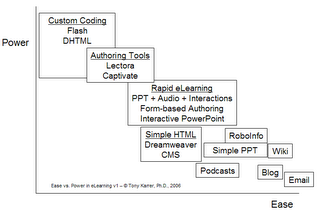
and consider some of Learning Trends then my current belief is that there is a drive towards using tools that are lower cost and that include the ability to insert higher power capabilities at particular points.
This looks very much like what Dion is talking about in his article, but he takes it a step further by defining it as an architecture for development. This is somewhat like Authoring in eLearning 2.0 / Add-ins & Mash-ups and Typepad Widgets - A Sign of Things to Come in eLearning Authoring / Developement. But I think that the idea of LAMS but based on composition is also inline with this future Point Solutions vs. Suites and Composition.
What's the bottom line? In five years, I would expect us to be building much less SCORM courseware and much more Wiki-like content (web pages) with some interactive exercises, simulations, etc. embedded based on other tools or add-ins. Collaboration will be part of the environment, but we'll still be struggling with getting collaboration to work effectively as part of the system - so we'll still underuse those features. Authoring will be as easy as editing a word document and updates are instantaneous.
Hopefully I'm the first to be saying it, but:
It's not dying anytime soon, but its reaching its zenith and will start a slow steady decline.
eLearning Trends, eLearning 2.0, web 2.0, Collaborative Learning, Informal Learning
Keywords: eLearning Trends, eLearning 2.0, Web 2.0, Informal Learning, Collaborative Learning
If you look at my picture of the range of tools:
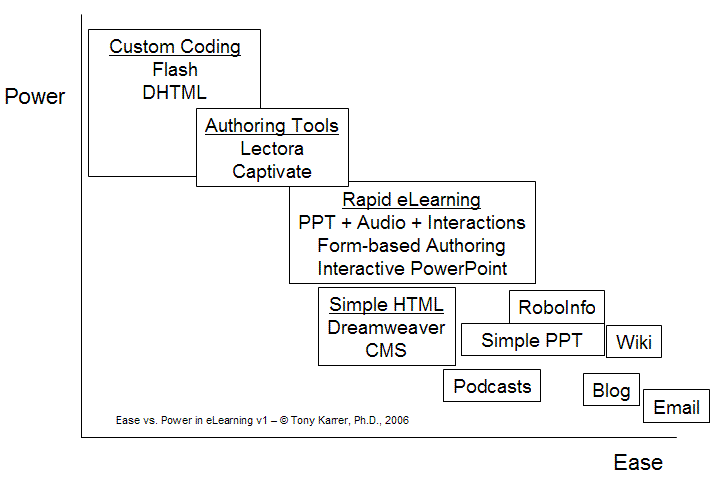
and consider some of Learning Trends then my current belief is that there is a drive towards using tools that are lower cost and that include the ability to insert higher power capabilities at particular points.
This looks very much like what Dion is talking about in his article, but he takes it a step further by defining it as an architecture for development. This is somewhat like Authoring in eLearning 2.0 / Add-ins & Mash-ups and Typepad Widgets - A Sign of Things to Come in eLearning Authoring / Developement. But I think that the idea of LAMS but based on composition is also inline with this future Point Solutions vs. Suites and Composition.
What's the bottom line? In five years, I would expect us to be building much less SCORM courseware and much more Wiki-like content (web pages) with some interactive exercises, simulations, etc. embedded based on other tools or add-ins. Collaboration will be part of the environment, but we'll still be struggling with getting collaboration to work effectively as part of the system - so we'll still underuse those features. Authoring will be as easy as editing a word document and updates are instantaneous.
Hopefully I'm the first to be saying it, but:
Courseware is the new instructor-led training
It's not dying anytime soon, but its reaching its zenith and will start a slow steady decline.
eLearning Trends, eLearning 2.0, web 2.0, Collaborative Learning, Informal Learning
Keywords: eLearning Trends, eLearning 2.0, Web 2.0, Informal Learning, Collaborative Learning
Wednesday, 21 June 2006
Tools and Strategies for Personal Learning
I just saw Harold Jarche's post: Adult Learning - pressing issues and where the field is headed, in two sentences. His two (actually three) sentences:
I tend to agree that while day-to-day I focus on formal training and performance support solutions, the real need is to help develop "practical tools and strategies" that help us learn. However, I feel like we are failing miserably in this area.
We (learning professionals) don't seem to know how to use these tools ourselves: Do Learning Professionals Make the Worst Learners? and More Questions on Making Learning for Learning Professionals More Effective.
And I have see lots of examples of tools out there, but I don't see lots of adoption nor do I see the practical strategies.
We need more pragmatic suggestions like I was trying to do in:
Personal Learning for Learning Professionals - Using Web 2.0 Tools to Make Reading & Research More Effective
What else are you finding that's helping you become a better learner in this "networked world."
If you have thoughts on this, I’m a regular reader so I’d love to see more blog posts on these tools and strategies.
The overwhelming majority of the learning needs of Canadian adults are not
addressed by formal training and education. In this post-industrial era, adults
today require self-directed learning skills to thrive in the unstructured work
environments outside of school. Efforts should be focused on the development of
practical tools and strategies for adults to learn in a networked information
society.
I tend to agree that while day-to-day I focus on formal training and performance support solutions, the real need is to help develop "practical tools and strategies" that help us learn. However, I feel like we are failing miserably in this area.
We (learning professionals) don't seem to know how to use these tools ourselves: Do Learning Professionals Make the Worst Learners? and More Questions on Making Learning for Learning Professionals More Effective.
And I have see lots of examples of tools out there, but I don't see lots of adoption nor do I see the practical strategies.
We need more pragmatic suggestions like I was trying to do in:
Personal Learning for Learning Professionals - Using Web 2.0 Tools to Make Reading & Research More Effective
What else are you finding that's helping you become a better learner in this "networked world."
If you have thoughts on this, I’m a regular reader so I’d love to see more blog posts on these tools and strategies.
Tuesday, 20 June 2006
Collaborative Online Assignments
I ran across a nice post Clive on Learning: In praise of collaborative online assignments where he suggests that we provide collaborative assignments in addition to self-paced, individual eLearning. I'm a big fan of this approach and have tried it in a few different forms. One was making the content primarily collaborative group projects at the start - Collaborative Learning Using Web 2.0 Tools - A Summary. Another was providing group assignments towards the tail end of particular sections.
Honestly, I've run into enough problems with this kind of approach in terms of synchronizing students, delays in their activity, poor performance by some students, drop-outs, etc. that I've only used it in a few cases. I'm curious if other people are finding success such as what Clive mentions.
Honestly, I've run into enough problems with this kind of approach in terms of synchronizing students, delays in their activity, poor performance by some students, drop-outs, etc. that I've only used it in a few cases. I'm curious if other people are finding success such as what Clive mentions.
Subscribe to:
Posts (Atom)

